Content creation
⟳Cross-post Remixer✂AI Clipper✦Hook Generator¶Caption Fit Checker✧AI Script Writerin app11 free tools. Zero signups. Your files never leave your browser.Open the Viral Lab →
From February 1, 2027, Shorts revenue needs 10 million qualified views every 90 days, and joining YPP gets harder. What changes and what to do now.
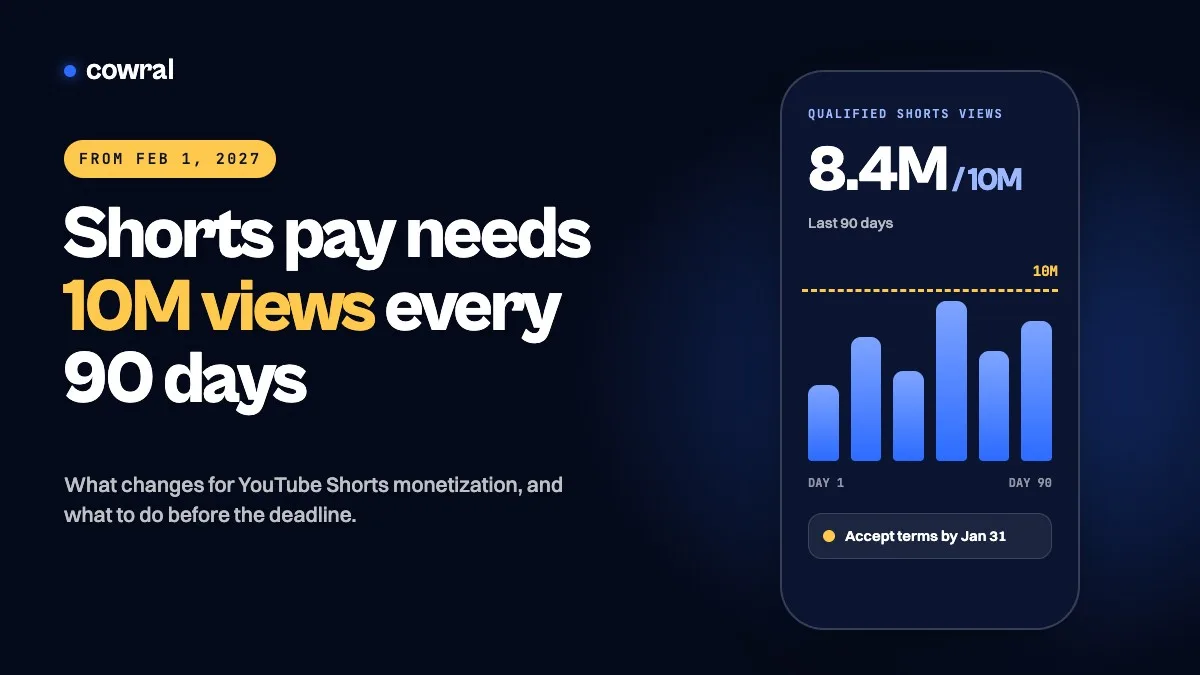
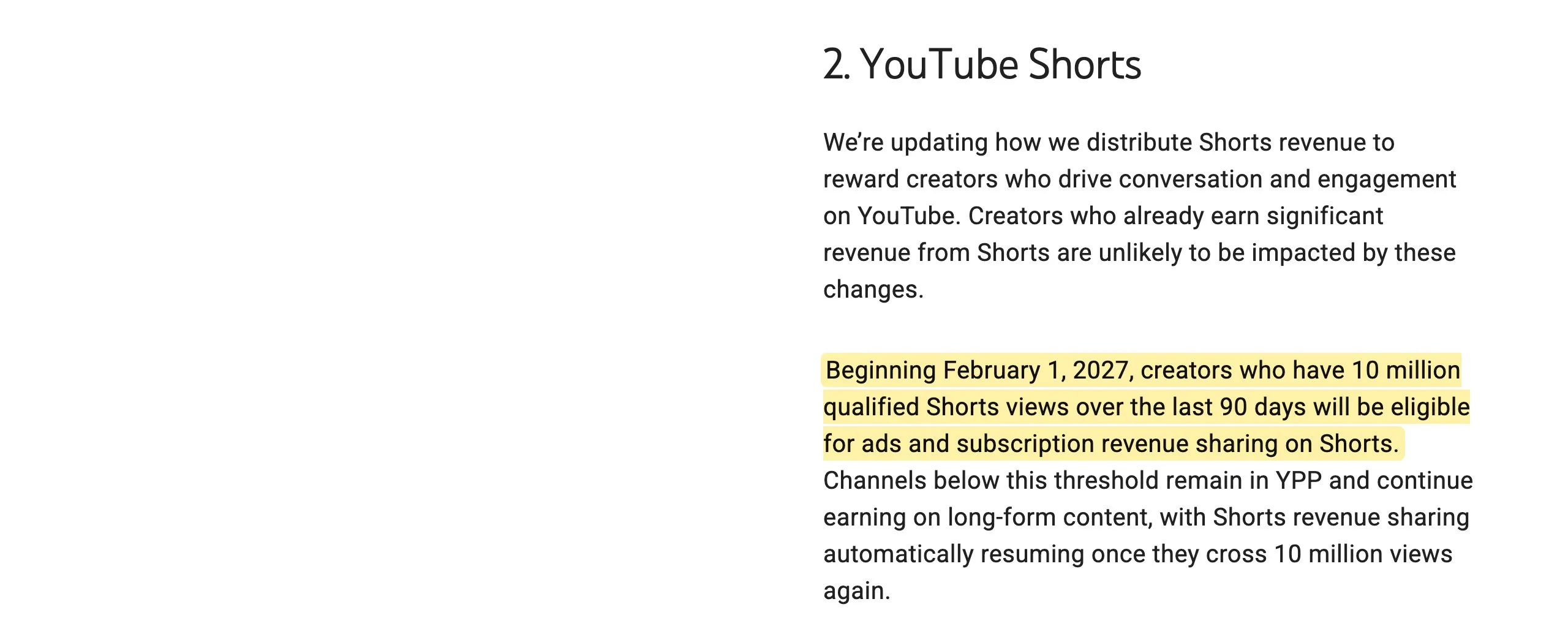
If you earn money from YouTube Shorts, or you’re working toward it, February 1, 2027 is the date to know. From then on, your channel needs 10 million qualified Shorts views over the last 90 days to get a share of Shorts ad and Premium revenue each month. That applies to creators already in the YouTube Partner Program, not just new ones. And new channels will need a lot more to get in: 1,000 subscribers plus 8,000 watch hours in a year, or 20 million Shorts views in 90 days.
Nobody gets removed from the program for falling under the Shorts line. If your channel drops below 10 million qualified Shorts views, it stays in the Partner Program, keeps earning from long videos, and starts sharing Shorts revenue again once it’s back over. But there’s one deadline you can’t miss: you have to accept YouTube’s updated terms by January 31, 2027, or you stop earning from those features on February 1.
Key takeaways
YouTube announced the changes on its official blog on August 10, 2026, and its help center now spells them out. Here they are in one place.
| Today | From February 1, 2027 | |
|---|---|---|
| Joining YPP for ads and Premium revenue (new channels) | 1,000 subscribers, plus 4,000 qualified watch hours in 12 months or 10 million qualified Shorts views in 90 days | 1,000 subscribers, plus 8,000 qualified watch hours in 365 days or 20 million qualified Shorts views in 90 days |
| Earning from Shorts ads and Premium | Be in YPP and accept the Shorts Monetization Module | Also have 10 million qualified Shorts views in the last 90 days |
| Under 10 million Shorts views | Still earn a Shorts revenue share | Stay in YPP and keep long-form earnings; Shorts revenue share pauses until you’re back over |
| Fan funding and Shopping | 500 subscribers, plus 3,000 watch hours or 3 million Shorts views | Unchanged |
| Ads targeted at 5 or fewer channels | Not offered | Those channels keep 45% of the ad’s net revenue, on top of the Creator Pool |
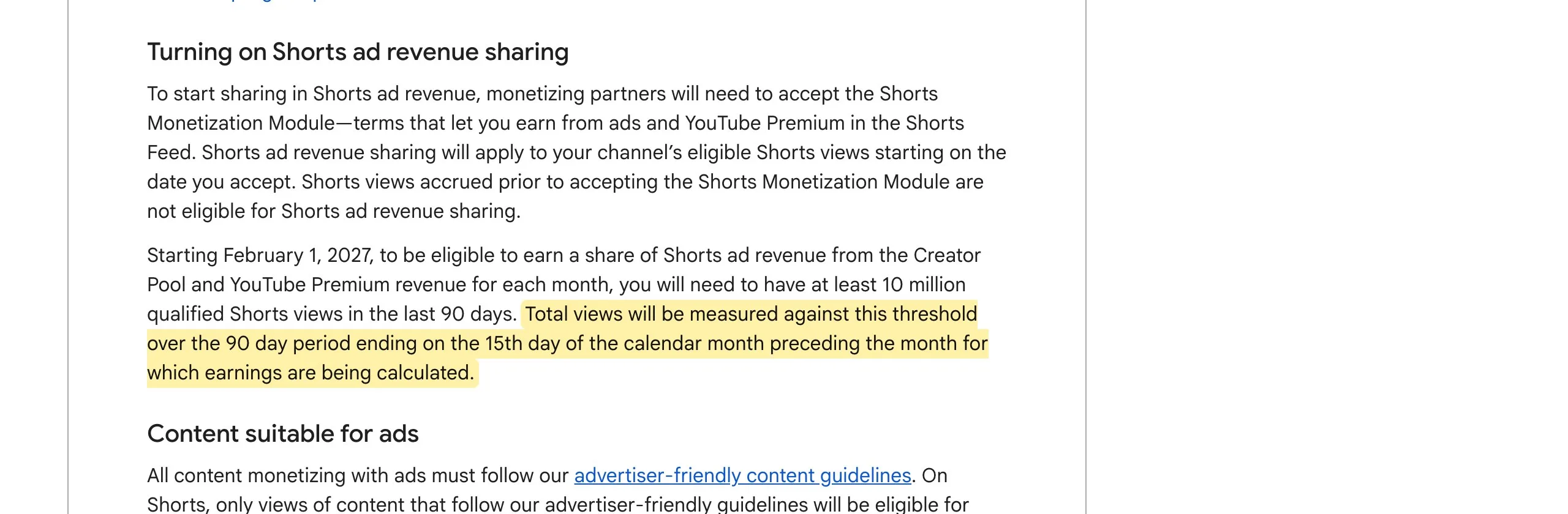
YouTube’s help page also gives the exact window. The 10 million views are measured over the 90 days ending on the 15th of the month before the month being paid. So whether you earn from Shorts in March depends on your views in the 90 days up to February 15.
For channels under the line, YouTube says it’s introducing incentive programs instead, which it says “may offer” extra money in a few forms: Shopping bonuses, credits toward producing brand deals, and higher pay for joining cultural trends. Eligible creators will be notified as these launch. There are no details yet on how much they’ll pay.
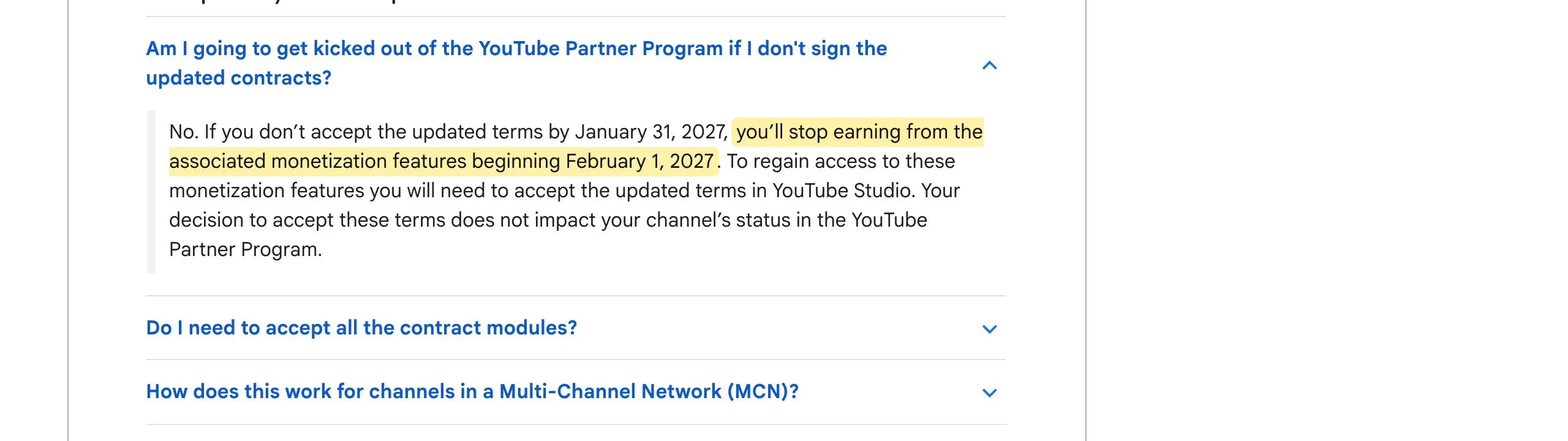
This part applies to every channel in the Partner Program, whatever your view count. YouTube’s help center says you need to review and accept the updated terms in YouTube Studio by January 31, 2027. If you don’t, you won’t be removed from the program, but you’ll stop earning from the features covered by the terms you didn’t accept, starting February 1. You get them back once you accept.
The terms come as modules: the Watch Page Monetization Module, the Shorts Monetization Module, and the Commerce Product Module if you use fan funding or Shopping. YouTube says you’ll find the notice on your Studio dashboard or in the Earn tab. Switched on memberships or Super Chat before 2023? Your fan funding terms might be an older version, and YouTube is moving everyone onto the Commerce Product Module, so you’d accept that one too.
If your channel isn’t in the Partner Program yet, today’s requirement for ads and Premium revenue is 1,000 subscribers plus either 4,000 qualified watch hours in 12 months or 10 million qualified Shorts views in 90 days.
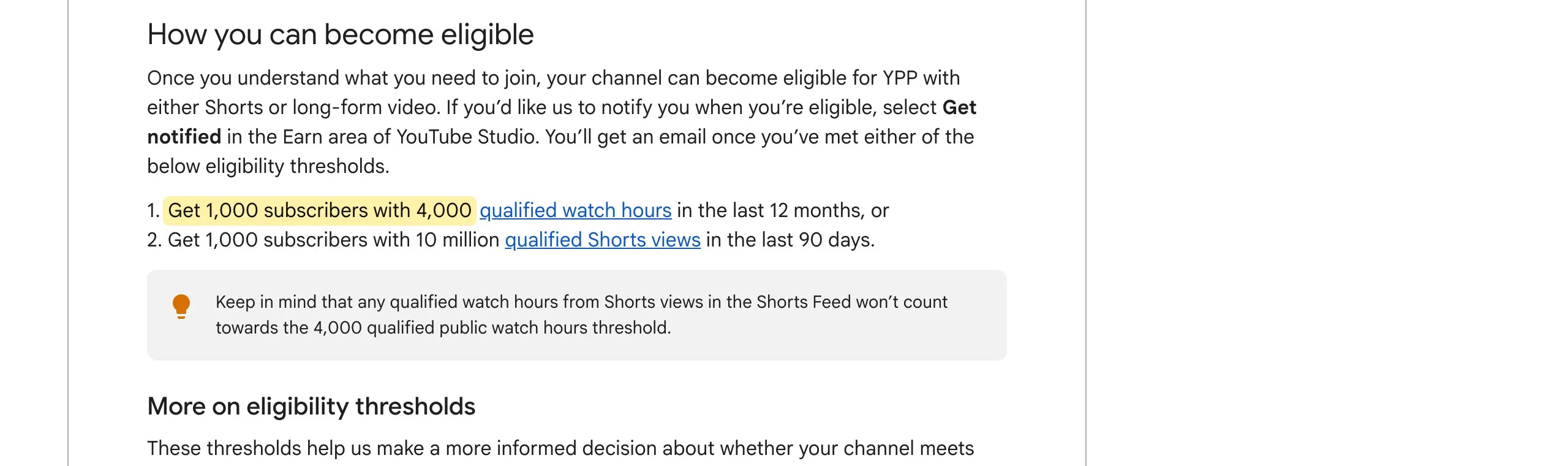
From February 1, 2027, new channels will need 1,000 subscribers plus 8,000 qualified watch hours in the last 365 days, or 20 million qualified Shorts views in the last 90 days. YouTube says channels already in the program keep their status.
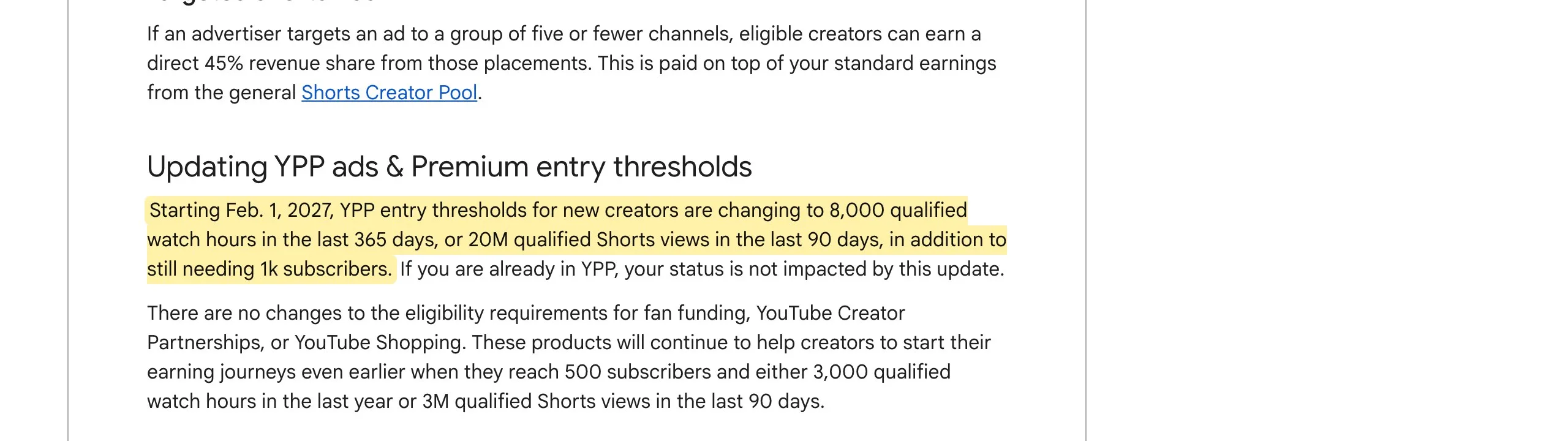
In daily terms, 20 million Shorts views in 90 days averages about 222,000 qualified views a day. On the long-form side, 8,000 hours in a year is about 22 hours of watch time a day.
If you’re close to today’s bar, the next few weeks matter. Getting into the program before February 1 means the higher entry bar doesn’t apply to you. YouTube hasn’t said how it will treat applications still in review on that date, so don’t leave it to the last week. And you’d still need 10 million Shorts views every 90 days to earn from Shorts, like everyone else.
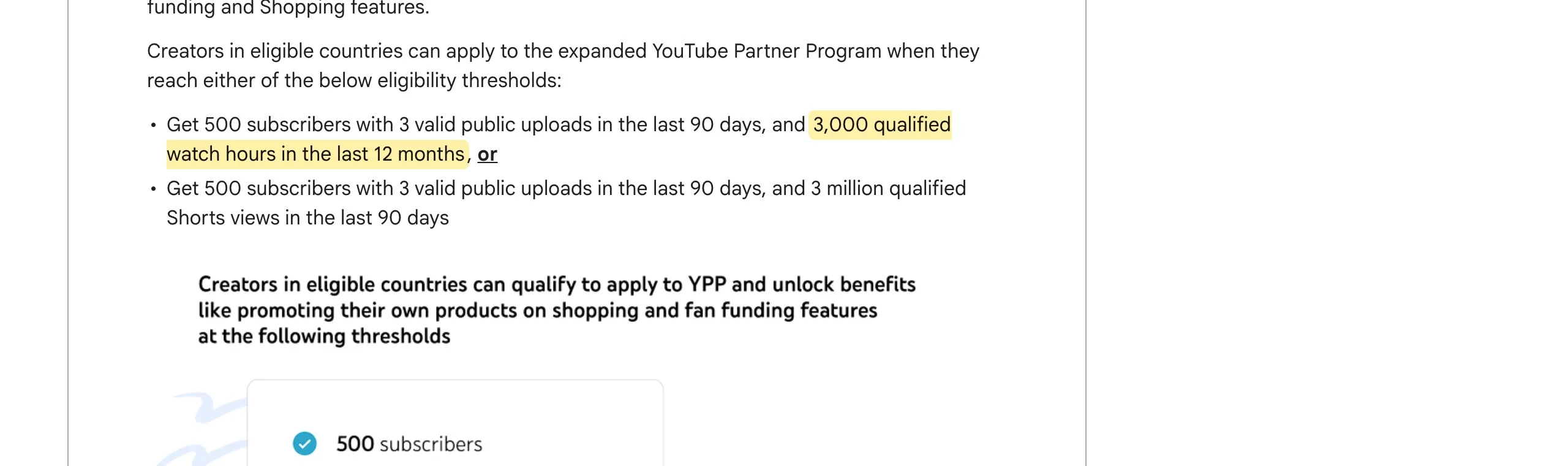
If you’re further away, the lower tier is worth knowing about. It isn’t changing. With 500 subscribers, 3 public uploads in the last 90 days, and either 3,000 qualified watch hours in 12 months or 3 million qualified Shorts views in 90 days, you can apply for fan funding and Shopping. That means channel memberships, Super Chat, Super Stickers, Super Thanks and Shopping. It’s available in the US, the UK, Canada, Germany and many other countries, which YouTube lists on its expanded program page.
There’s one more change that’s easy to miss. From February 1, 2027, YouTube counts your channel as active in the Partner Program if you meet any one of these:
If a channel drops below those, YouTube says it gets a 90-day window to get back to either 1,000 watch hours or 1 million Shorts views to stay in the program. Most channels that post regularly will clear the upload option without thinking about it.
Every threshold above uses qualified views, not the view count on your Short. YouTube explained the difference in a separate post. A qualified Shorts view has to come from a public Short and be an engaged view, meaning the viewer stayed past the first few seconds, without counting loops.
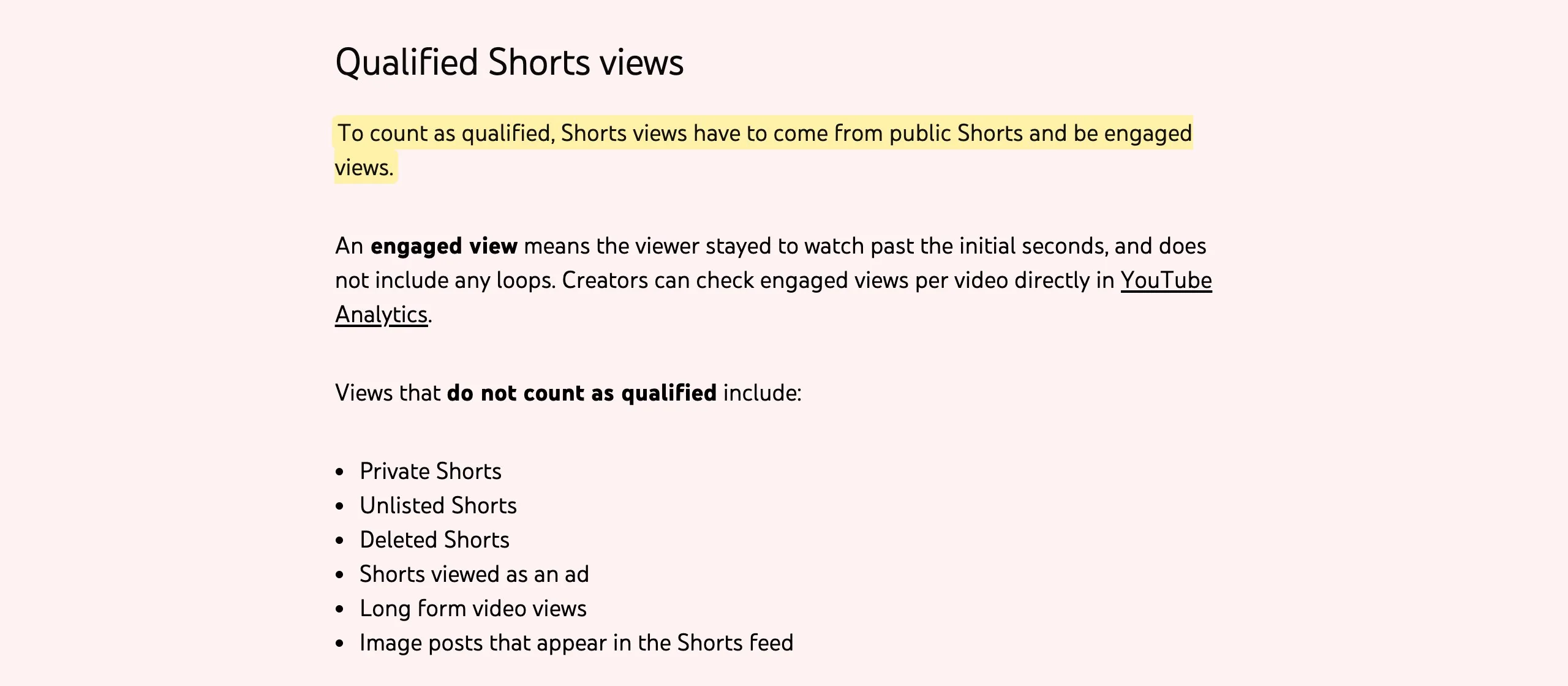
Views on private, unlisted or deleted Shorts don’t count, according to the same post. Neither do views of Shorts shown as ads, long-form views, or image posts that turn up in the feed. And Shorts watch hours never count toward the 4,000 or 8,000 watch-hour bars.
This matters because the two numbers can be far apart. Since 2025, YouTube counts a Shorts view the moment it starts playing, so the public count includes people who swiped away right away. YouTube says you can check engaged views for each Short in YouTube Analytics. Our guide to short-form retention metrics shows where to find them and what they tell you.
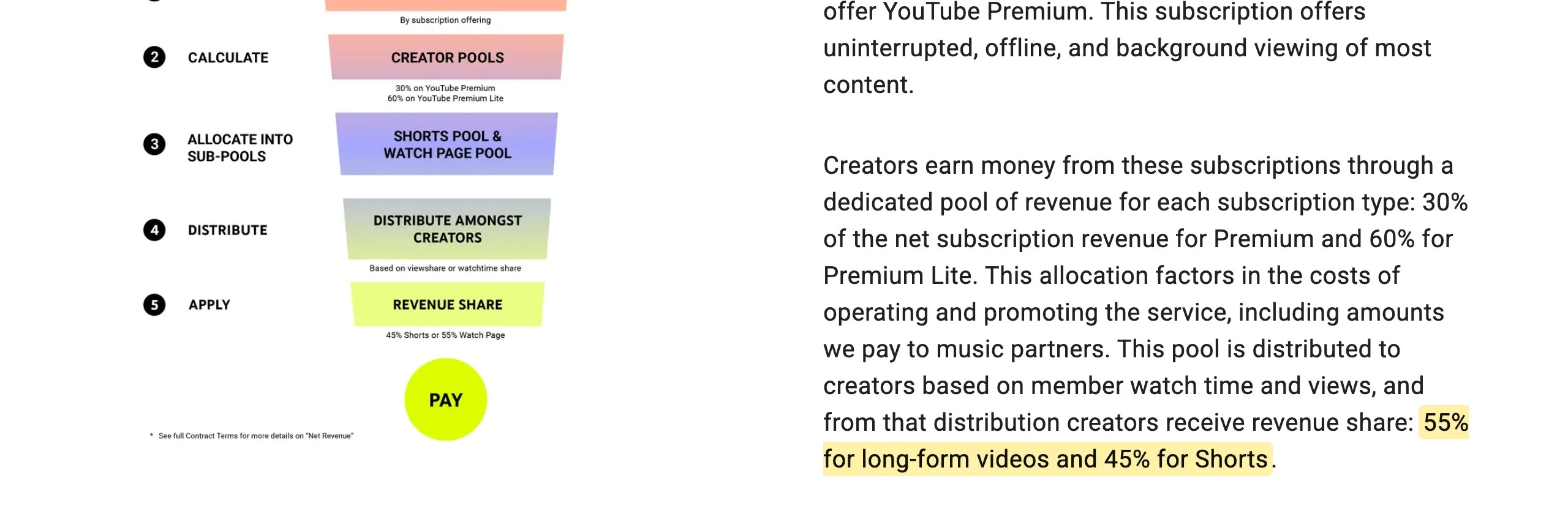
Shorts don’t earn like long videos, where you get a share of the ads on your own video. Ads in the Shorts feed play between Shorts, so YouTube pools them. Its help page describes four steps:
YouTube gives its own worked example. Say a country has 100 million engaged Shorts views and $100,000 of Shorts feed ad revenue in a month. If 20% of those Shorts use one music track, $10,000 goes to music and the Creator Pool is $90,000. A Short with 1 million engaged views gets 1% of the pool, $900. After the 45% share, the creator earns $405 for that Short’s views in that country.
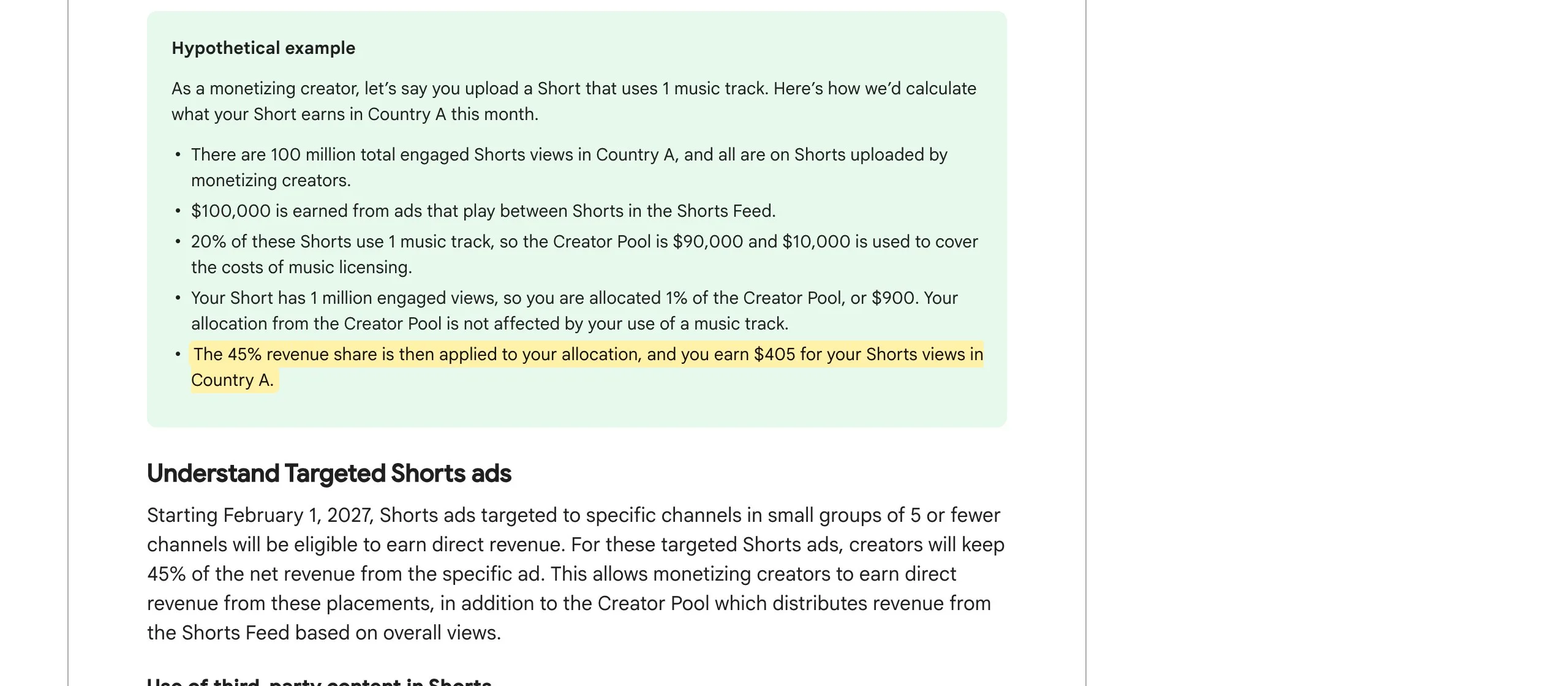
Those numbers are hypothetical, not a rate. YouTube doesn’t publish a per-view rate for Shorts, because your pay depends on the size of that month’s pool in each country, how much went to music, and your share of views. Treat any “Shorts pay $X per 1,000 views” figure you see online as an estimate.
YouTube Premium works the same way for Shorts: creators keep 45% of the Premium revenue allocated to Shorts, split by share of Shorts views from subscribers in each country. YouTube’s announcement says the Premium split is 55% for long-form and 45% for Shorts.
A few things can stop a Short from counting at all, according to YouTube’s policy page. Non-original Shorts, like unedited clips from movies or TV, re-uploads of other creators’ videos, or compilations with nothing original added, don’t count. Neither do fake views from bots, or Shorts that break the advertiser-friendly guidelines. And a Short over a minute long with claimed content in it is blocked, so it can’t earn at all.
Ten million qualified views in 90 days works out to about 111,000 qualified views a day on average. You don’t have to hit that every day. A strong month can carry two quiet ones, because the check looks at the whole 90-day window.
YouTube says creators who already earn significant Shorts revenue are unlikely to be affected. The channels that will notice are in the middle: in the Partner Program, posting Shorts regularly, but averaging under 111,000 qualified views a day. For them, Shorts revenue could pause in February while long-form earnings carry on.
You can’t change the rules, but you can be ready for them. Here’s where we’d start.
None of this guarantees you’ll stay over 10 million. It just means February won’t catch you off guard.
We make Cowral, so weigh this accordingly. Cowral can’t change YouTube’s thresholds or tell you what YouTube will pay. It helps with the part you control: finding ideas that are trending in your niche, writing hooks and scripts for Shorts and long videos, and planning a posting week with reminders so you post consistently. If you also post to TikTok and Reels, our cross-posting guide covers sharing one video across all three without hurting it on any of them.
Until February 1, 2027, you can join the YouTube Partner Program with 1,000 subscribers and 10 million qualified Shorts views in the last 90 days, or 4,000 qualified long-form watch hours in 12 months. After that, new channels need 1,000 subscribers and 20 million qualified Shorts views in 90 days, or 8,000 watch hours in a year. Every channel will also need 10 million qualified Shorts views in the last 90 days to earn Shorts revenue each month.
No. YouTube says channels below the threshold stay in the Partner Program and keep earning from long-form content. Shorts revenue sharing starts again when you’re back over 10 million qualified views in 90 days.
You stay in the program, but starting February 1, 2027 you stop earning from the features whose updated terms you didn’t accept. You can accept them later in YouTube Studio to turn those earnings back on.
No. Watch hours from Shorts in the Shorts feed don’t count toward the 4,000-hour bar, and the qualified watch hours definition excludes Shorts watch hours. Only public long videos (podcasts count) and archived livestreams add to them.
YouTube doesn’t publish a rate. Shorts earnings come from a monthly pool in each country, split by share of engaged views after music licensing, and you keep 45% of your share. In YouTube’s own hypothetical example, 1 million engaged views earned $405, but real pools vary by country and month.
The entry bar for fan funding and Shopping isn’t changing. But if you’ve had them switched on since before 2023, YouTube may ask you to accept its newer Commerce Product Module by January 31, 2027 to keep earning from them.

Olu Sam is an SEO expert and social media content creator who built over 50K followers across his social media pages in less than a year of creating content.
LinkedIn ProfileHow we research and fact-check YouTubevidIQ vs TubeBuddy in 2026: which one is worth paying for?vidIQ vs TubeBuddy, compared on price, AI credits, A/B testing and Shorts, using each company's own pages.
 AI for creatorsOpusClip alternatives in 2026: 10 tools comparedLooking for an OpusClip alternative? We compared 10 AI clipping tools on free limits, watermarks and what four one-hour episodes a month...
 YouTubeYouTube now counts a view the second a video starts. Here's the number that tells you if your hook workedSince August 24, 2026, YouTube counts a view the moment any video starts to play. Here's which retention numbers on YouTube, TikTok and...